
Homily, 22nd Sunday in Ordinary Time

August 28, 2022 -- Msgr. Joseph K. Ntuwa • August 30, 2022

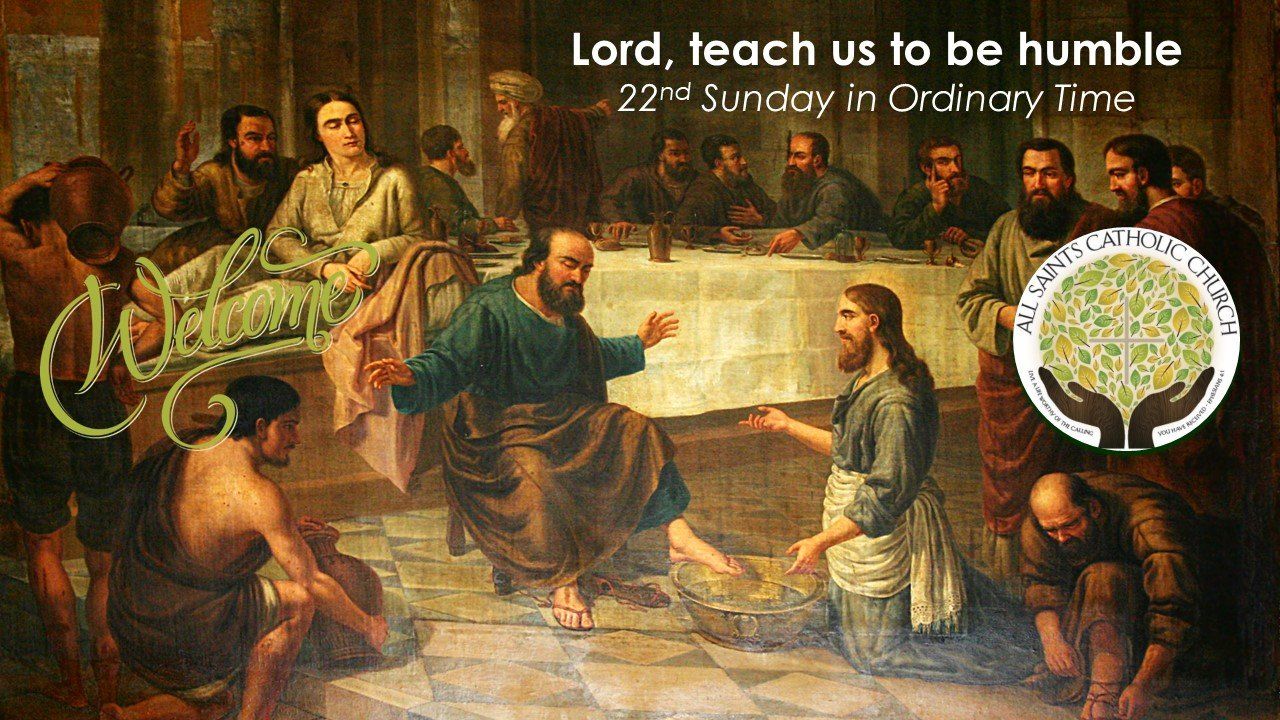
Lord, teach us to be humble

Readings: Sirach 3:17-18, 20, 28-29; Hebrews 12:18-19, 22-24a; Luke 14:1, 7-14


Every culture has a different understanding of sharing a meal. In first-century Palestine, a culture that was defined by honor and shame, sitting down to eat with another was an act of acceptance and respect. Meals affirmed the status of those invited – usually of the same social rank as the host.


But in today’s Gospel we get the impression that Jesus has been invited with an ulterior motive as the Pharisees were observing him carefully, perhaps trying to trap him in some cultural or ritual infringement. As the meal progresses, Jesus tells two parables. As they were watching him, so was he observing their behavior. And having seen how they schemed for the best seats at table, Jesus uses the image of the wedding banquet and its seating arrangements to remind them of the true meaning of humility.


Sirach’s call to act with humility in our affairs (our first reading) connects nicely with Jesus’s words to take the last place rather than place of honor in the dining room. Taken together, they remind us that real humility is grounded in seeking God’s favor and placing others before ourselves. By using the banquet image and the possibility of having to give up one’s seat to another of higher rank, Jesus not only highlights the potential for human embarrassment but reminds his listeners that by initially taking the lower position there is equally the potential for greater esteem if one is bought up to a higher position.


This is a very practical lesson for all of us, one that can be applied to daily living on so many levels – at home, at places of work or school. It reminds us that it is not one’s social or intellectual status that is being criticized by Jesus, but how we use those gifts in our interactions with others. The one who is given the task of leadership at any level should not seek to dominate those in their care but be a servant leader, relying on God for strength. They should recognize their own limitations and humanity, when compared to the all-embracing wisdom and love of God, the giver of all gifts.


The virtue of humility is often underappreciated in a world where success and prestige are so highly admired. True humility is not putting ourselves down, or refusing to accept a compliment. Truly humble people acknowledge their strengths and weaknesses in a realistic way.


St Augustine suggests that humility is the foundation of all other virtues- patience, compassion, gentleness, and gentleness. Humility grows best as we learn to accept that we are loved, loved unconditionally, with our strengths and failings – by precious friends, and especially by God. A great model of humility is Mary who, though a pregnant but unmarried young woman with an unlikely story, in a village presumably of gossipers, still “exulted in God” who, she could say in the one breath, “looked on his servant in her lowliness” and at the same time "did great things for her”. Real humility is a witness to the Holy Spirit within us.


I remember the caution of our General Spiritual Director at the Seminary. He used to wisely warn against what he called, “humility with a hook” – doing something that looked humble in order precisely to be honored. Rather than an exercise in humility, it is something motivated by pride, by the desire to be thought well of by others. What matters is not to look humble but to be humble.


Being humble requires trust and contentment. When we are fearful of being overlooked or anxious about how we are perceived, we begin to grasp at “exaltation”. When we strive after the world’s approval it will never satisfy us. But when we let go of this desire, when we are free from prisons of pride, when we stop grasping at acceptance and recognition, we can finally know the peace of God.


May God grant us that receptive heart and attentive ear, that with wisdom and humility we may love God and one another with a sacrificial love.

Jesus, Meek and Humble of Heart, make my heart like unto Thine.

Homilies

By Dawn Nelson • November 7, 2025
Homily All Souls 2025
By Dawn Nelson • September 22, 2025
Homily 9/14/25
By Dawn Nelson • August 13, 2025
19 th Sunday of the Year C Wis 18:6-9 Heb 11:1--12 Lk 12:35-40 It is often said that life is a journey. Well, this is not a journey like traveling from one point to another on a map. In fact, some people live for quite a while before they even realize that they are on a particular, personal journey. However, the most challenging aspect of our life’s journey is, always, the unknown. We all have hopes, dreams, and aspirations and our plans are made based upon those hopes and dreams. Probably, the most important plan for each of us is our basic vocation, either to be married and have a family of our own or to be a priest, religious or single person and serve the human family at large. Choosing marriage means finding the right spouse for what will be a mutually shared journey. Serving the human family means discovering a way that suits our talents and abilities. In all of this, there is the unknown and the unforeseen. No matter who we are, or what direction we take, we cannot know beforehand everything we will face on our particular journey. I vividly recall the anxiety on my day of ordination caused by the fear of the unknown, even though I had been preparing for that day for over eight years! Consequently, we realistically need both faith and hope. We need faith in ourselves and in whomever we share the journey. We need a well-founded hope – a deep trust – that we will achieve the purpose and final outcome of the journey. What most people never realize is that God is calling us on this journey . God has a plan and a purpose for each of us in the divine scheme of things. Today’s scriptural readings invite us to trust in God’s ways . The first reading from the book Wisdom recalls the Passover – the last of the ten plagues on the Egyptians and the most destructive of them all. It was the one that finally convinced Pharaoh not only to let God’s people go, but actually to force them out. God’s chosen people had been slaves in Egypt for more than 400 years, each generation saying the same prayer, waiting on God to free them and bring them home. God’s people awaited the salvation of the just and the punishment of their adversaries. The letter to the Hebrews (our second reading) recalls Abraham’s unwavering faith in God’s promise. The author states that faith is an openness of mind and heart, not merely a set of propositions. He turns to Abraham’s faith to illustrate this. Abraham’s faith showed itself in his willingness to depart from his home and leave his kin, to trust a promise that his descendants would outnumber the stars, and to trust that God will provide even when he was asked to sacrifice the son who guaranteed the promised future. Through all this a covenant was initiated. As we know, those who claim Abraham as their ancestor in faith include Jews, Muslims, and Christians- billions of people! With Jesus, came a new covenant in his blood, and a call to all his followers. This was to replace any fear people might have with an abiding trust in God to give them the promised kingdom. And Jesus spoke about having a fidelity that would characterize his followers as good servants, good stewards in the household of faith. The hallmarks of this fidelity would be watchfulness for the master’s return, a commitment to guarding treasures of the household and caring for its members. Therefore, dear friends, we are urged to serve God throughout our spiritual journey with steadfastness by doing the best we can in every situation. Putting our faith in God can seem like walking blindly into the dark—with no assurance that we have heard correctly or that God is there to catch us if we fall. Yet that is what Abraham (our ancestor in faith) did. For his trust, he was accounted righteous. Let us pray for the gift of that same unshakeable faith. Remember , God has a plan for each of us - always present and accompanying us each step of the journey.
By Dawn Nelson • August 4, 2025
18th Sunday in Ordinary Time Ecclesiastes 1:2; 2:21-23; Colossians 3:1-5, 9-11; Luke 12:13-21 I think you will agree with me that most of us like to be in control. We like to shape the world around us and steer things in the direction we choose. For instance. · How many of us feel the need to choose the social lives of our family and friends -, where we’re going to eat, where we’re going to go on vacation? · How many of us want to be the spouse who sets the rules (and punishments) for our children? · How many of us want to get our way at work, or even on the road? Yes, we do like to be in control. No doubt about that. And we probably act that way for a number of good reasons . But the biggest reason might be a simple one --- because we think we can protect ourselves from bad things, from the things we don’t want, and from people acting in ways we don’t like. Put simply --- our need to “control” might at its core simply be a misguided need to try to ensure our “happiness”. Well, I say “misguided” because deep down, we know things don’t really work that way. Disappointments find us. Sorrow finds us. Tragedy hits us. Failure finds us!!! “Vanity of vanities . . ..! All things are vanity……For what profit comes ….from all the toil an anxiety of heart” So begins the Book of Ecclesiastes. Is the author of today’s first reading a pessimist or a realist? ‘Vanity of vanities, all is vanity’ might suggest that all our efforts are in the end unstable and futile ­­– a breath of wind blowing dust around. For those of you who don’t know --- this book is not a “warm and fuzzy” one. Its message isn’t that “everything is going to be wonderful”. It’s much more in line with what we know from personal experience. And that means it’s kind of a tough read. So, what is the human author driving at? Let’s go straight to our Gospel reading from Luke in which Jesus tells a parable showing the fleeting nature of the material things of this world and the fleeting nature of our individual lives. This parable about storing large amounts of grain for the future recalls the story of Joseph and the Pharoah in ancient Egypt (Genesis 41). Where Joseph is praised for his wisdom to store up grain for the seven lean years to come, the rich man in today’s gospel is criticized for what sound like the same thing. Why? The fundamental difference is in the purpose of these people’s actions. Joseph, interpreting Pharaoh’s dream, advised the entire country to store grain during years of plenty so that people all over the country, and the wider region would not starve during the years of famine. The greedy rich man, however, only stores his harvest so that he himself could live off it for years, so he could do nothing but “rest, eat, drink, and be merry!” (Luke 12:19). Joseph saved hundreds of thousands of people with the stored grain across the country. The rich fool only wanted to save himself. And he sadly failed. Dear friends, life is more relational than material . We do not exist as isolated individuals. The rich man in the parable is condemned as a fool precisely because he isolates himself from human relationships, and relationship with God, which alone can make us unhappy. Earthly things are good, but they can never satisfy the human heart. St Augustine clearly put it “Our hearts are restless until they rest in you”. Jesus did not condemn wealth as such, but the attitude of mind that wealth consists in accumulating stuff, rather than forming loving relationships, especially with God, who alone can satisfy our longings. As Christians we are called to live this life as gateway to eternity- our true home is not this passing earth, but the new heavens and the new earth. Everything belongs to God, and we are stewards or caretakers who are expected to use the gifts in service to one another. Questions to reflect on for the week: Are you in control of your possessions, gifts and talents or are they controlling you? What are you storing in your heart?” Is it unforgiveness, habitual sinfulness, or bitterness? May we become rich in what matters to God so that our treasure will last forever!
July 29, 2025
17 th Sunday of the Year C Gen 18:20-32; Col 2:12-14; Luke 11:1-13 Have you ever had conversations with people who have expressed a distaste for many of the beliefs and practices of organized religion ? Sometimes these criticisms come from people who have had “bad” religious experiences in their own families or have seen what they feel is an ugly side of faith. I understand that. Some others have been hurt and disappointed by the common failings and faults of some of the faithful in the pews. Many others have been particularly crushed by the serious sins of Church leadership. Yet, there are others who simply are trying to be intellectually honest --- people who have truly wrestled with some of the big questions of life and faith and have been relatively unsatisfied with the “answers” religion provides. They “want” to believe at some level but just find too many obstacles. And sometimes that “obstacle” is the image of God presented to them. One particular element of Christianity that I hear criticized so often is the way we seem to ask God for things over and over again. Many people assert that they just, don’t understand why it needs to be this way! They argue: God knows everything. God knows exactly what we need (and want). So why do we need to ask? God has infinite power . There are no limits to what he can do. We don’t have to try to get his “attention” because he is “busy” elsewhere. So why do we need to ask? God is immutable --- which means, unchanging and unchangeable . That means we kind of diminish God if we think we can somehow “ change” his mind. So why bother to pray if God has already written the script? Well, today, in both our First Reading and Gospel passage, we hear examples illustrating the power of pleading with God. In the story from Genesis, we see Abraham “bartering” with God --- seeing if he can somehow get the best “deal” possible. Apparently, Abraham is wise enough to not ask for everything all at once, as if he’s using his charm to coax God’s mercy out of him. God goes along with each of his requests. And in the Gospel passage from Luke --- Jesus tells a story about a man banging on his friend’s door at midnight trying to get some bread for an unexpected guest. The friend initially refuses, but then gets worn down from the persistence of the man and gives in. After relating that story, Jesus utters these “famous” words, “Ask and you will receive; seek and you will find; knock and the door will be opened to you.” So, what gives? Do we have to “beg” God to get his blessings or does God actually withhold good things from us until we “wear him down”? Do we have to be expert negotiators, or charmers? Dear friends, an authentic spiritual life is about none of those things. It’s about a relationship supported, strengthened and transformed in part by a holy conversation --- what we call the divine conversation. This is a conversation that has no beginning and no ending, but rather is one that has been continual from the very dawn of time --- a sacred conversation which enables channels of grace to remain open within every single person --- a kind of listening and speaking that helps each of us remain open to an outpouring of God’s life which has the power to change absolutely everything. And so, we bring our needs to our God because we believe he loves us more than we can imagine, because we trust in his wisdom and power, because we need to put into words the deepest longings of our hearts. And maybe most importantly --- we ask, seek, and knock simply because it opens us up to every good thing God wants for us (and from us). Prayer encourages dependence on God and today’s parable shows us perseverance. We do not “keep knocking” because God isn’t aware of our needs but, rather, because we need to remain constantly aware of our daily need for him – our daily bread. Whenever we turn to God in prayer, we put our minds and hearts in contact with the very source of life and truth. And that refreshes the human soul, just as rebooting your computer refreshes the software that makes the computer run. When stress, discouragement, and frustration start to clog our circuits, we don't need to jack up the voltage by working more hours or by distracting ourselves with even more exciting entertainment; no, we need to reboot, we need to pray with perseverance. When you pray say” “Behold, I am your servant, do with and in and through me according to your will” In happy moments, seek God, in hard moments praise God, in quiet moments, trust God, in every moment, thank God. Lord Jesus, teach us to pray.
By Msgr. Joseph K. Ntuwa • March 2, 2025
8th Sunday in Ordinary Time -- Msgr. Joseph K. Ntuwa
By Msgr. Joseph K. Ntuwa • February 23, 2025
Homily, “Do unto others as you would have them do to you” 7th Sunday in Ordinary Time
By Msgr. Joseph K. Ntuwa • February 16, 2025
Sixth Sunday of Ordinary Time -- Homily by Msgr. Joseph Ntuwa
By Msgr. Joseph K. Ntuwa • February 7, 2025
Homily - The Presentation of the Lord - February 2, 2025
By Msgr. Joseph K. Ntuwa • February 4, 2025
Homily - 3rd Sunday in Ordinary Time - January 26, 2025