Homily, 3rd Sunday of Advent 2021
Homily, 3rd Sunday of Advent -- December 12, 2021
Zephaniah 3:14-18a; Philippians 4:4-7; Luke 3:10-18
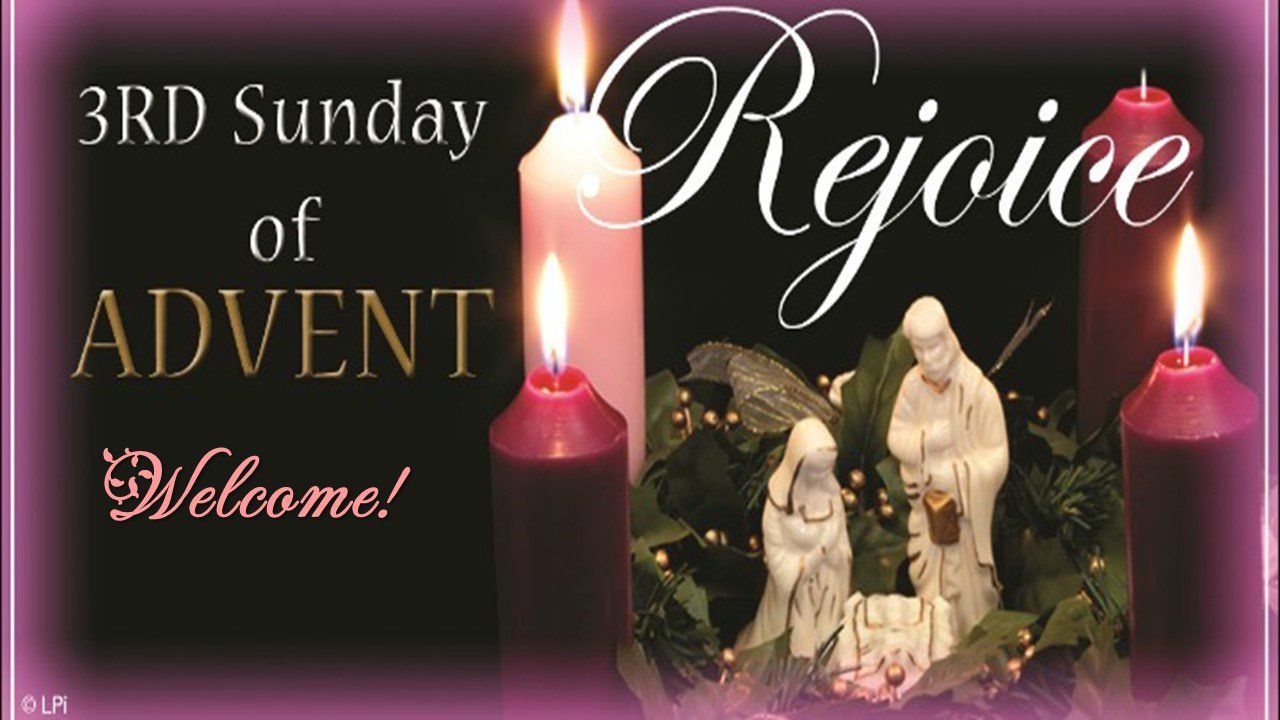
“Rejoice in the Lord always, and again I say rejoice”. Joy is the theme for this Third Sunday of Advent also known as Gaudete which means ‘rejoice’ in Latin. In today’s Gospel, three different groups – the crowds, the tax collectors and the soldiers approach John the Baptist and ask him; “What should we do?” John responds with incredibly practical answers. He didn’t ask them to do more prayers or ask them to do more sacrifices in the Temple but called them to a new kindness that was a sign of something deeper. It was a new way of treating everyone- like God continually treated them. He asked them to do some basic things.
• share your extra stuff.
• give some food to someone who has none.
• don’t cheat anyone and don’t practice extortion.
• don’t lie and don’t get greedy
In simple terms, he tells them “Don’t do bad things” And the “things” he’s telling them to avoid are things that everyone already knows, not just for those who were listening to John two thousand years ago, but all of us in this time and place.
We know what is “right” by what we have been taught by our parents, teachers and friends. We know what is “right” by seeing similarities in the moral teachings of many faith traditions throughout human history. We know what is “right” by what our Church teaches and urges us to live out. And most importantly we know what is “right” by that voice within each of us, our conscience --- that whisper of truth striving to inform our every word and action.
In the gospel, John the Baptist connects the announcement of the Good News with a call to action. Our actions should be just and fair. To live a life of discipleship in this way can be a source of profound joy. That is why it is important to make a distinction between happiness and joy. Happiness is more of an external sort of thing. It’s what we feel when things outside of ourselves go the way we want or provide us with some moment of fun or excitement. But as soon as those things are absent, the happiness we were experiencing fades, weakens and disappears. Then, we start to plan for the next time we can have that same experience of happiness. On the other hand, joy comes from the inside. Joy comes from what’s going on in our hearts and minds and souls. And for the Christian, joy starts with the realization of what God has done for us in the person of Jesus. It starts with the realization of how near our God is to us, and how much he loves us. Joy comes with not simply knowing “about” Jesus but with actually knowing him, being in an authentic relationship with him and accepting him as Lord.
That is what John was trying to accomplish in the desert. Many people came to see him, but he quickly diverted their attention elsewhere and tried to get them to be ready to encounter the one who would baptize them “with the Holy Spirit and fire”. Therefore, belief and trust in Jesus is the seed of a joyful life and that joy grows only when we love others. It grows every time we forgive, every time we show mercy. It grows every time we show compassion, are generous, or reach out to someone who is lonely, or embrace someone who is broken and full of sorrow. It is our actions that truly allow the joy within us to remain, grow and infuse every corner of our lives.
Many of you volunteer for some sort of good cause, for instance at a food pantry or a hospital or a nursing home. How do you feel when the meals were served, or holy communion given to the sick and homebound? That’s joy. We are called to give of ourselves to others, to make our kindness known to all, as St Paul says in the second reading. In doing so joy is spread. In what ways can you spread joy in your family, in your neighborhood and in the world?
Homilies